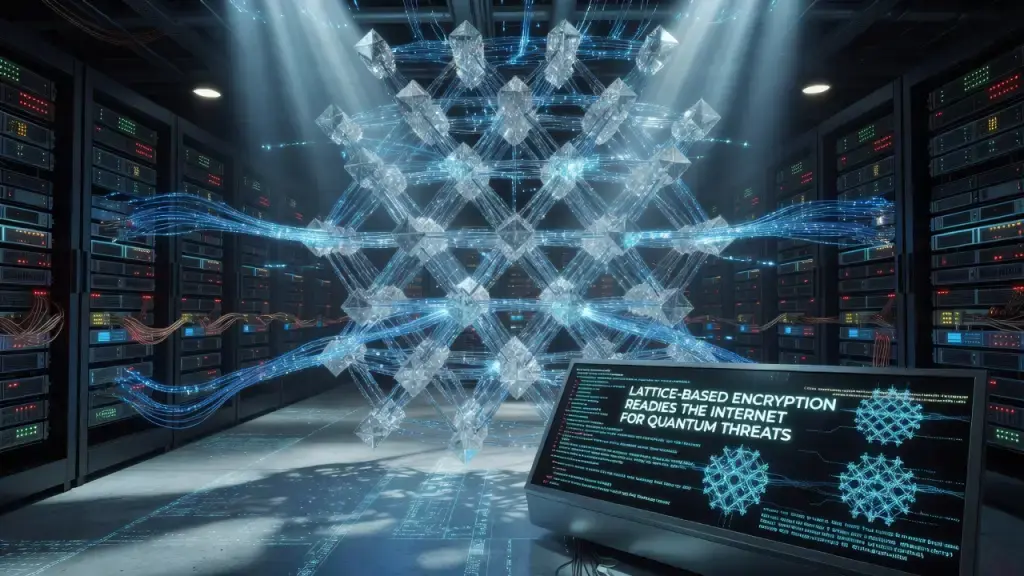
A mathematical shift now underway in internet security could determine whether encrypted data stays private for decades to come. Key Encapsulation Mechanisms, the post-quantum cryptographic standards recently formalized by the U.S. National Institute of Standards and Technology under the name ML-KEM (formerly known as Kyber), are being built into the handshakes that protect web traffic, financial transactions, and government communications. The reason is urgent: a sufficiently powerful quantum computer running Shor's algorithm would be able to break the RSA and Elliptic Curve Diffie-Hellman systems that currently secure most encrypted connections.
Today's public-key cryptography relies on mathematical problems - factoring large numbers, solving discrete logarithms - that are computationally infeasible for classical machines but fall apart under quantum computation. ML-KEM replaces that foundation with lattice-based mathematics, a different class of problem believed to resist both classical and quantum attacks. The mechanism works somewhat like sealing a combination inside an intricate, multidimensional mechanical puzzle: only the party holding the correct lattice structure, or "blueprint," can unlock the chamber and retrieve the shared key. Everyone else is left turning the puzzle in the dark. Readers wanting a broader overview of how encryption choices affect everyday browsing and tunneling tools can consult http://buybestvpn.com for additional context on how these protocols intersect with consumer-facing privacy services.
Why "Harvest Now, Decrypt Later" Changes the Calculus
Intelligence agencies and other well-resourced actors do not need a working quantum computer today to benefit from one tomorrow. Encrypted traffic can be intercepted and stored now, then decrypted retroactively once quantum hardware matures - a strategy widely referred to as "store now, decrypt later." Communications considered sensitive for ten, twenty, or thirty years - medical records, diplomatic cables, corporate trade secrets - are the most exposed under this model, since the value of secrecy often outlasts the current limits of computing power. KEMs are designed specifically to close that window, ensuring that intercepted ciphertext remains unreadable even after quantum decryption becomes feasible.
From Standard to Infrastructure
ML-KEM is no longer theoretical. Cloudflare and Google Chrome have already incorporated post-quantum key exchange into production TLS 1.3 handshakes, meaning ordinary web sessions now benefit from quantum-resistant protection without users noticing any change. Financial networks and national security systems face a more structured transition, often guided by regulatory timelines requiring migration away from quantum-vulnerable algorithms. The shift is gradual by necessity: cryptographic infrastructure is deeply embedded across hardware, software, and legacy systems, and wholesale replacement takes years of coordinated engineering.
What Remains Unresolved
Lattice-based schemes are not without trade-offs. Key sizes are generally larger than those used in classical elliptic-curve systems, which can affect bandwidth and storage in constrained environments. Cryptographers also continue stress-testing these new standards, since any newly deployed mathematical assumption carries some residual uncertainty compared to decades-old, heavily scrutinized systems. Even so, the consensus among standards bodies is that the risk of inaction - leaving data permanently exposed to future decryption - outweighs the costs of early adoption.