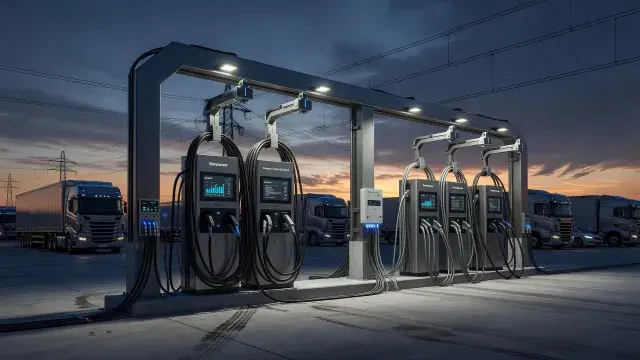
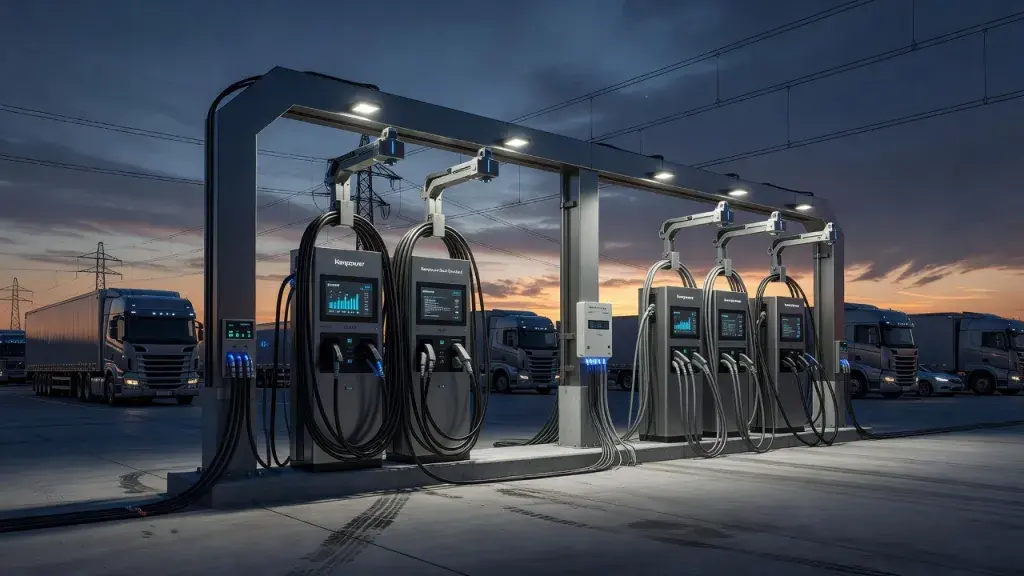
Kempower has introduced a charger designed to solve one of the thorniest problems in electric freight: how to build charging infrastructure that serves both cars and heavy trucks without duplicating costly hardware. The Mega Satellite Flex, unveiled this week at the ACT Expo in Anaheim, delivers up to 560 kW through the established CCS standard or up to 1.2 MW through the emerging Megawatt Charging System, all from a single dispenser.
The timing reflects a genuine fork in the road for charging technology. CCS has been the workhorse for passenger EVs for more than a decade, but it was never engineered for the power demands of long-haul electric trucks, which need to recharge massive battery packs in the time a driver takes for a mandated rest break. MCS is the industry's answer, and it's still in its early build-out phase. Just as consumers weigh practical trade-offs when choosing a charging network, understanding how VPN companies make money offers a useful analogy for how infrastructure providers balance upfront investment against long-term service revenue - a calculation Kempower is clearly making with this dual-protocol approach.
One Site, Two Standards
The core pitch is avoidance of stranded investment. Charging site operators have historically faced a binary choice: build for passenger vehicles now and add truck infrastructure later, or gamble on early truck-charging demand that may not materialize for years. The Mega Satellite Flex removes that binary. A single unit can serve a passenger EV today and a Class 8 truck tomorrow, without a second construction project, a second grid connection application, or a second set of permits.
That flexibility also extends to newer 800-volt vehicle platforms, an architecture increasingly common in premium EVs and now spreading into mainstream models. Higher voltage systems allow faster charging without proportionally higher current, reducing thermal losses and cable heating. A charger that can flex across voltage and current profiles is better positioned to stay useful as vehicle platforms evolve, rather than becoming obsolete when the next generation of battery packs arrives.
Technical Specifications and Practical Limits
The numbers matter because they define what's physically possible at a given site. The unit supports up to 1,500 amps on the MCS side and 700 amps for CCS, with cable lengths of 5 meters for CCS and 2.7 meters for MCS - the shorter MCS cable reflecting the different connector geometry and cooling requirements at that power level. An integrated payment terminal option signals that Kempower expects at least some of these sites to serve public or semi-public charging markets rather than depot-only fleets.
- Up to 560 kW via CCS, 1.2 MW via MCS
- 700 A maximum for CCS, 1,500 A maximum for MCS
- Cable lengths of 5 meters (CCS) and 2.7 meters (MCS)
- Compatible with Kempower's existing distributed charging architecture
- Optional integrated payment terminal
Why Utilization Is the Real Metric
Charging hardware is expensive, and idle chargers are the fastest way to erode a return on investment. By letting one dispenser serve two vehicle categories, Kempower is directly targeting utilization rates rather than raw charging speed alone. Compatibility with the company's existing distributed power-sharing systems means operators already running Kempower infrastructure can add the Mega Satellite Flex without re-engineering their electrical backbone, an important detail for anyone trying to scale a charging network under real budget constraints.
The Mega Satellite Flex is expected to reach North American and European markets in July 2026. That gives operators over a year to plan sites, but it also puts Kempower in a race against other manufacturers racing to define the practical standard for megawatt truck charging before infrastructure decisions harden into place.